
People
To read about people click their name here:
Samuel Voake ~ A Murderer ~ Trial and execution
MURDER MOST FOUL
In 1823 Samuel Voake was sentenced to death for attempted murder. The following are newspaper reports of the trial and his final execution.
ATTEMPT TO MURDER A GAMEKEEPER.
Samuel Voke. aged 23, was indicted on the capital charge of maliciously and wilfully shooting at Thomas Pearse, gamekeeper to Lord Glastonbury, with intent to murder him. The prosecutor appeared in court with a handkerchief bound round his head and a patch over his eye, He stated that on the 3rd July last, he went to Lord Glastonbury’s manor of Compton Dundon, between 8 and 9 o’clock in the evening; hearing a gun go off, he alighted from his horse, and on going to the place, found the prisoner with a gun in his hand, the ramrod of which was broken in the middle; prosecutor told him he was doing a wrong thing, and giving him a great deal of trouble. The prisoner asked him to pardon him; prosecutor told him if he would go with him to Mr. Ryall, the steward, he might do it, to which the prisoner consented, and they walked on side by side ; prosecutor went a few yards before the prisoner to get his horse, and the prisoner fired his gun at his back, but said nothing. Prosecutor turned round and saw him running away, but could not follow him, because he thought his back was broken ; prosecutor mounted his horse to return home, and when about half a mile on the road his horse looked towards the hedge ; prosecutor turned his eyes in the same direction, and saw Samuel Voke hid behind the hedge, and immediately received a charge from a gun in his face, which beat out one of his eyes and seven of his teeth; prosecutor put his hand upon his head, and exclaimed You d—d cowardly son of a b… , I believe thee hast done me now.” When prosecutor went to the prisoner the first time, he had only a stick in his hand, about the size of a tobacco pipe he is 66 years old. (The prosecutor’s clothes were here shewn to the jury a fustian coat was perforated with numerous shot; the prosecutor was loosely clothed with thick garments, which probably prevented the shot from taking its full effect )

When he was shot the second time, it was light enough to see to shoot anything; the prisoner was close beside an ash tree. Cross-examined by Mr. Bompass — Prisoner’s father rents the field where I saw him with the gun ; no angry words passed between us; when I saw him first, his gun was cocked, and when he walked by my side, he carried it in his hand hanging down; I was a quarter of an hour riding half a mile, because my back was so painful; I saw the prisoner’s face, and brown coat, when he fired the second time , he was only 3 or 4 yards from me ; his ramrod was broken short off therefore half of it could not be long enough to ram down a charge.
Mr. Ryall, steward to Lord Glastonbury, was the next witness; remembers Pearse coming to him covered with blood, between 9 and 10 o’clock on the 3d July ; he had lost one eye, 5 or 6 of his teeth were knocked out, and there were 13 or 14 shot wounds round his face and neck ; witness found a broken bit of ramrod in the prosecutor’s hat ; in his back there were marks of 20 or 30 shot, and some had penetrated the skin. Witness applied poultices to the injured parts, and sent for a surgeon. Cross-examined. — A gun may go off by accident, when cocked, if the lock be not a good one; striking against a person’s side would not affect a good lock. Pearse came to his house about half past nine; it is about a mile and a half from the place where Pearse was shot the second time. Mr. Bond, surgeon, of Glastonbury , stated that he attended the prosecutor the 3rd July, and found the sight of one eye destroyed, a small wound on the left temple, several teeth gone, and shot-wounds about the face. The prosecutor was in a very precarious state for some days, but is now out of danger. Witness found severe contusion in his back, and extracted seven shots from it. Aaron Hindow said, that Pearse took him on Monday last to the place where he said he was shot the second time. The morning after he was shot, witness found a piece of ramrod and some shot in the field, close to where it occurred, and three smaller bits in the road outside the hedge. [They were here shewn to the jury ; the small bits appeared blackened with gunpowder.]The hedge by the ash tree is about breast-high.
John Underwood apprehended the prisoner 20 miles from Compton Dundon on the 4th July, and asked him if he knew Thomas Pearse ; to which he replied,* No!’ Some time afterwards he repeated the question, and the prisoner told him, he knew him ten years ago. Being charged with the assault, he said, he had not had a gun in his hand for a twelvemonth. This was the case for the prosecution. A witness was then called for the prisoner, who gave him a good character for peaceable conduct. The Judge, in summing up the evidence, remarked that the only question for the jury decide was the identity of the prisoner, because if they had no doubt that he was the person who fired at the prosecutor, there could be none as to his intention, and the case would be fully made out. The prosecutor had given the prisoner no provocation, so as to have operated in inducing retaliation, and therefore the charge could not, if the man had died, have been reduced to manslaughter. It would in the eye of the law have been murder. This gun stick being broken was a material fact, as connected with the pieces found in the road and in the prosecutor’s hat; and when the size of the shot was considered, they being as large as duck shot, there could be no doubt the prisoner intended to murder the gamekeeper, and would have done so if the charge had entered his head or back in a body, instead of being scattered. The circumstance of the prisoner being 20 miles from his parish the day after the transaction, without giving any legal-cause, was another important fact for consideration of the jury. If they thought the charge was brought home to him, the law must take course ; but if they entertained any doubt, they would, in conjunction with the character that had been given, find him not guilty.
The jurv consulted a few minutes, and returned a verdict of Guilty. Mr. Bompass then rose to move an arrest of judgment, on an informality in the indictment, and contended that in all the counts of the indictment, the particular act or acts upon which the malicious intention was founded were not distinctly stated. The charge of maliciously shooting was divided into two branches, and the averment should have been distinctly made to apply to one or both, instead of indefinitely stating as aforesaid. Mr. Moody, for the prosecution, replied to the objection, but his Lordship said he would reserve the point for the consideration of the Judges.
The Judge then proceeded to pass sentence, and told the prisoner, that although the objection which had been raised by his Counsel against the indictment would postpone his execution for some time, the best advjce he could give him was to prepare for another world,, He had been convicted, upon the clearest evidence, of attempting to murder a peaceable and inoffensive man, for which his life was justly forfeited to the laws of his country. His Lordship concluded by passing sentence in the usual way. (Taunton Courier and Western Advertiser Aug 1823) (Execution. —On Wednesday last, Samuel Voke underwent his sentence, at Ilchester. From the time , of his trial he never entertained the slightest hope of life, and has been assiduous in his attention to the instructions and exhortations of Mr. Valentine, the pious chaplain of the gaol, from which he derived the greatest spiritual comfort, and entire preparation for his fate. Having expressed a wish to see his prosecutor, Pearse visited the gaol on Sunday the 23rd ult., when a mutual pardon was exchanged, and they took leave of each other on the most friendly terms.
At an early hour on Wednesday morning, Mr. Valentine visited the prisoner, and administered the Sacrament to him, and they continued in prayer and religious conversation till the awful moment was at hand. Before he left his cell he expressed in the warmest terms his gratitude to the Chaplain, as well as to Mr. Hardy and the officers of the gaol, for their kindness. At eleven o’clock he ascended the platform, and having prayed with the clergyman for a quarter of an hour, he continued for about five minutes in secret aspiration to his Maker; the rope was then adjusted, and the signal having been given, in a few minutes life was extinct. Voke was a remarkably fine young man, about 24 years of age, the son of respectable parents, who occupy a small farm at Compton Dundon, Poaching, considered by young men of his class a venial offence, became in him the parent of a frightful crime; the interruptions given to him in his unlawful pursuits by Pearse, in the performance of his duty, led to that desire for vengeance, and thirst for blood, which so fatally recoiled upon his own head.—it has been erroneously stated that was attended in the prison by a dissenting minister; we are assured that he received religious instruction from the chaplain alone.
(Taunton Courier and Western Advertiser Dec 1823)
Oliver Shutler
Oliver Shutler (1838-1916) lived in a stone built thatched cottage on the junction of Peak Lane and Hayes Lane, between where ‘At Last’ and ‘Ferndale’ stand now. He lived a very ‘interesting’ life but his main claim to fame is that he sang folk songs for Cecil Sharp, the well-known collector of English folk music.
Oliver was remembered as living in ‘a fair-sized house’ with an orchard, and working as a carter when he was not poaching. In his early days he had been ‘a wrestler, a bruiser and a performer of wonderful feats of strength’. In several censuses he was described as an agricultural labourer. He was voted to become a Parish Councillor, when they were created in the 1890’s.
On the 20th January 1906, Cecil Sharp visited the home of Oliver Shutler and recorded two songs, “Lord Bateman” and “True Lover’s Farewell”. Oliver was no doubt in a poor state by the time he sang to Cecil, as his life had begun to fall apart by then.
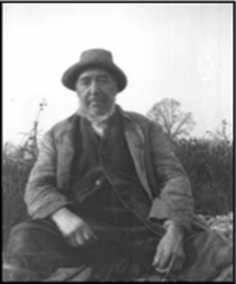
The following is an entry from the EFDSS Website: (efdss.org)
Oliver Shutler (1838-1916): age 68, 2 songs 20 Jan 1906: Oliver’s story seems rather sad. He was baptised on 3/3/1838 at Pitney church, 2 miles south of Somerton. He was the only child of John Shutler, a modest farmer and his wife Ann (née Salway). Theirs was a late marriage (in 1837 John was 31 and Ann 36). Ann died in Jan 1850, when Oliver was just 12 years of age. Four years later in Jan 1854, aged 16, Oliver was sentenced to 6 months in Wilton Gaol, Taunton for cattle stealing (England & Wales, Criminal Registers, 1791-1892 HO 27; Piece: 109; p182).
Aged 22, he got married on 4/3/1860 at Compton Dundon church to a widow Mary Ann Hollard, 12 years older than him. She had no children by her first marriage and Oliver would have no children either. Moving away from Pitney, Oliver perhaps received a settlement from his father and bought a house and orchard in Compton Dundon. Oliver did a spot of poaching and was once fined £8 for shooting a partridge. But his wife Mary Ann died 29/7/1903 aged 80. Letter at VWML from Prebendary SH Cooke of Compton Dundon (14/2/1974) stated that ‘At the end she was in such an awful condition that the police intervened.’
Oliver may already have been on the bottle but now he went to pieces. ‘He had to sell his house and lived rough, sleeping in barns etc. He wore an old-fashioned white smock and was often near to starving. He wintered in the Langport Union workhouse and did stone-breaking in the summer months’. Bob Patten noted that according to the Sheffield Daily Independent 12/3/1907 Oliver was ‘an old stonebreaker, who had been in his early days a wrestler, a bruiser and a performer of wonderful feats of strength’. But he was no doubt in a poor state when Sharp found him in Jan 1906. Oliver was in Langport workhouse for the 1911 census and died in Mar 1916 (Langport 5c 496) aged 78.
The following references are courtesy of the British Newspaper Archive:
Alfred Taylor, 20, and Oliver Shutler, 16, were charged with stealing a mare, value £30, the property of Mr. John Tazewell, at Chedzoy, on the 24th of September. Mr. Broadmead appeared for Shutler. Taylor was sentenced to five years penal servitude, and Shutler to six months’ hard labour. (Wells Journal January 1854)
In 1870 Oliver Shutler and William Andrews were appointed Parish Constables for the Somerton Division.
SOMERTON. Petty Sessions, Monday.—Before R. N. Grenville.Esq., Capt, Stuckey, and F. W. Pinney, Esq. —Oliver Shutler, of Compton Dundon, was charged with violently assaulting George Crossman, of Ashcott Committed for six weeks’ hard labour.
( Western Gazette August 1871)
Poaching—Oliver Shutler, Joshua Atwool, labourers, and Obed Bartlett, farrier, of Compton Dundon, were summoned for trespassing in search of game—lsaac Kingsbury, gamekeeper in the employ of R. N. Grenville, Esq., M.P., deposed that on the 10th instant, about quarter to seven in the morning, he saw the three defendants in a field occupied by Joseph Brewer, at Compton Dundon. Shutler killed a partridge, and witness saw him pick it up. The two defendants were walking close by him, and each carried a gun. They were beating over the mangold in the field for nearly half an hour. He went to Bartlett, and said to him ” I didn’t think you had been the man to do this,” he replied, “It was the first time he had done it.” He did not speak to the others. He saw Bartlett conceal his gun in the field, and he went and found it. Bartlett was close by, and he said, ” Is this yours ?” and he replied, ” It was once, but you have got it now.” The gun was loaded and full cocked, and he fired it off in the air. Bartlett asked him if he intended to keep the gun, and he told him he should take the gun home. Close to where the gun was he found a dead partridge, which was fresh killed, and blood was still running from it.—Cross examined by Shutler . He was about 150 yards from him when he shot.—Cross-examined by Bartlett : He did not see him kill anything; but he was there.—James Hill, under gamekeeper, fuliy corroborated the last witness, and said he had not the slightest doubt as to the identity of the defendants.—Atwool and Shutler denied being there ; but Bartlett admitted walking through Mr Brewer’s field, whom he was friendly with, but denied having a gun or being in search of game.— He called Mr Brewer, who said he rented the farm of the Earl of Ilchester, but he had not the right of killing the game.—The magistrates considered the case fully proved, and fined each defendant £1 7s. 6d., including costs.—As Bartlett would not own the gun the gamekeeper was told by the magistrates to keep it. (Western Gazette September 1876)
Oliver Shutler, of Compton Dundon, labourer, was summoned by the Excise officers for killing game without having a license to do so. Fined £20 mitigated to one-fourth Obed Bartlett and Joshua Attwood, of Compton Dundon, were charged with carrying a gun not having a license to do so. Fined £2 10s, one fourth of the full penalty. (Central Somerset Gazette December 1876)
When Parish Councils were established in the late 19th Century, Oliver was one of the first Councillors to be elected.
COMPTON DUNDON. Parish Council.—The first meeting of the Parish Council was recently held in the School-room. Present: The Chairman of the parish meeting (Rev. J. W. A. Sturdee, vicar), the Assistant-Overseer, and all the Council, viz., Messrs. W. Dawbin, E. Cox, W. White, O. Shutler, and J. E. Hobbs.— (Taunton Courier, and Western Advertiser January 1895)
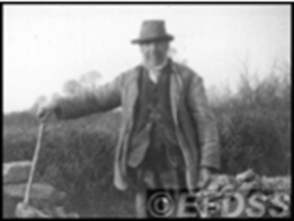
COMPTON DUNDON PARISH COUNCIL –The annual parish meeting was held on Thursday evening last, to elect five persons to act as the Parish Council for the ensuing year. The Rev. J.W.A. Sturdee (vicar) presided over an attendance of 50. Seven nomination papers were handed in, and the voting was attended with the following result: – Mr E. Cox, builder, 40; Mr. Dawbin, farmer, 40; Mr. E. Hobbs, farmer, 34; Mr. O. Shutler, agriculturalist, 34; Mr. W. White, farmer, 34; Mr. E. Richards, labourer, 12; and Mr. M. Green, shoemaker, 6. Ten minutes were then allowed if a poll should be demanded. The Chairman explained that it would now take five electors to demand a poll. The ten minutes having expired and no poll called for, the first five (all the old members) were declared duly elected. (Central Somerset Gazette March 1897)
RURAL DISTRICT COUNCIL HOUSING COMMITTEE REPORT
The Special Housing Committee reported that the report of the Housing Committee of (1) Compton Dundon (2) Charlton were presented and considered. With regard to (1) it was resolved to recommend that the Clerk he instructed to negotiate with the agent of Ilchester for the acquisition of (a) at Dundon, the site of an old house and garden, late Shutler’s. about half an acre suitable for two dwellings of the parlour type. (b) At Compton, part of an allotment field, about one acre, adjoining the Somerton main road, suitable for two dwellings; without parlours. (Langport and Somerton Herald August 1919)